

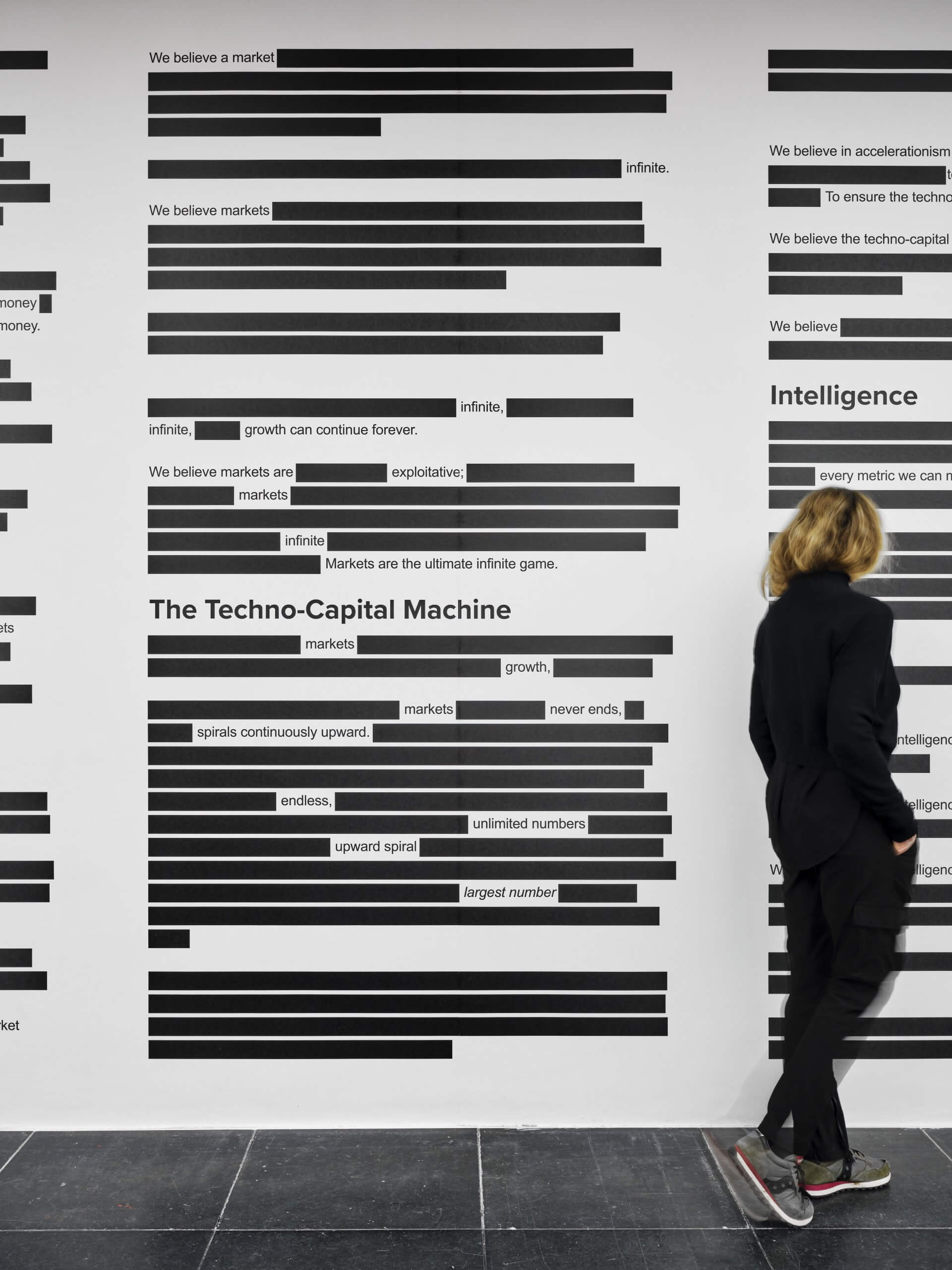

Ben Grosser
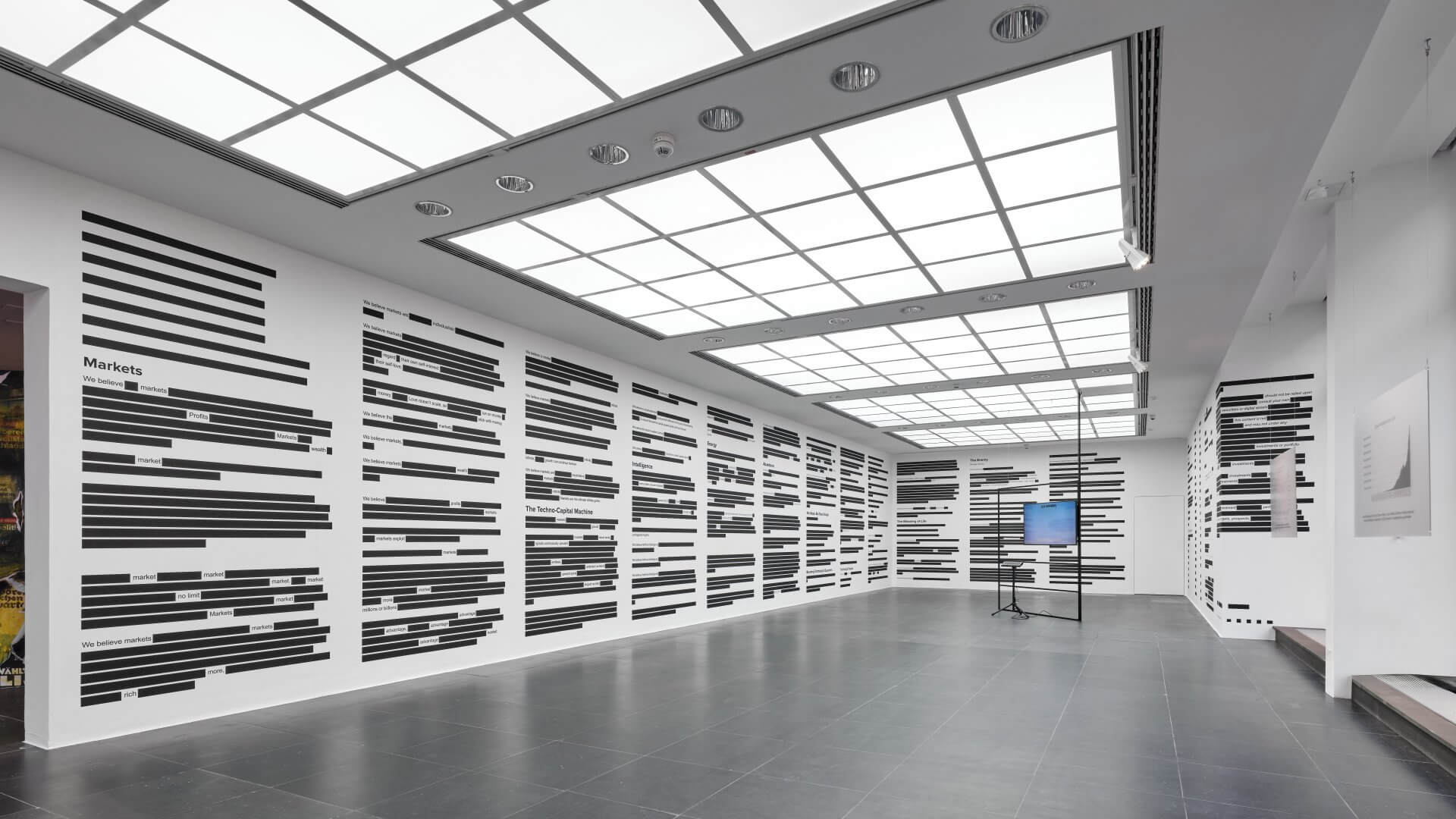
Redaction Poetry of Andreessen’s Techno-Optimist Manifesto, 2023
Wall graphic
ca. 35 x 3,25 m
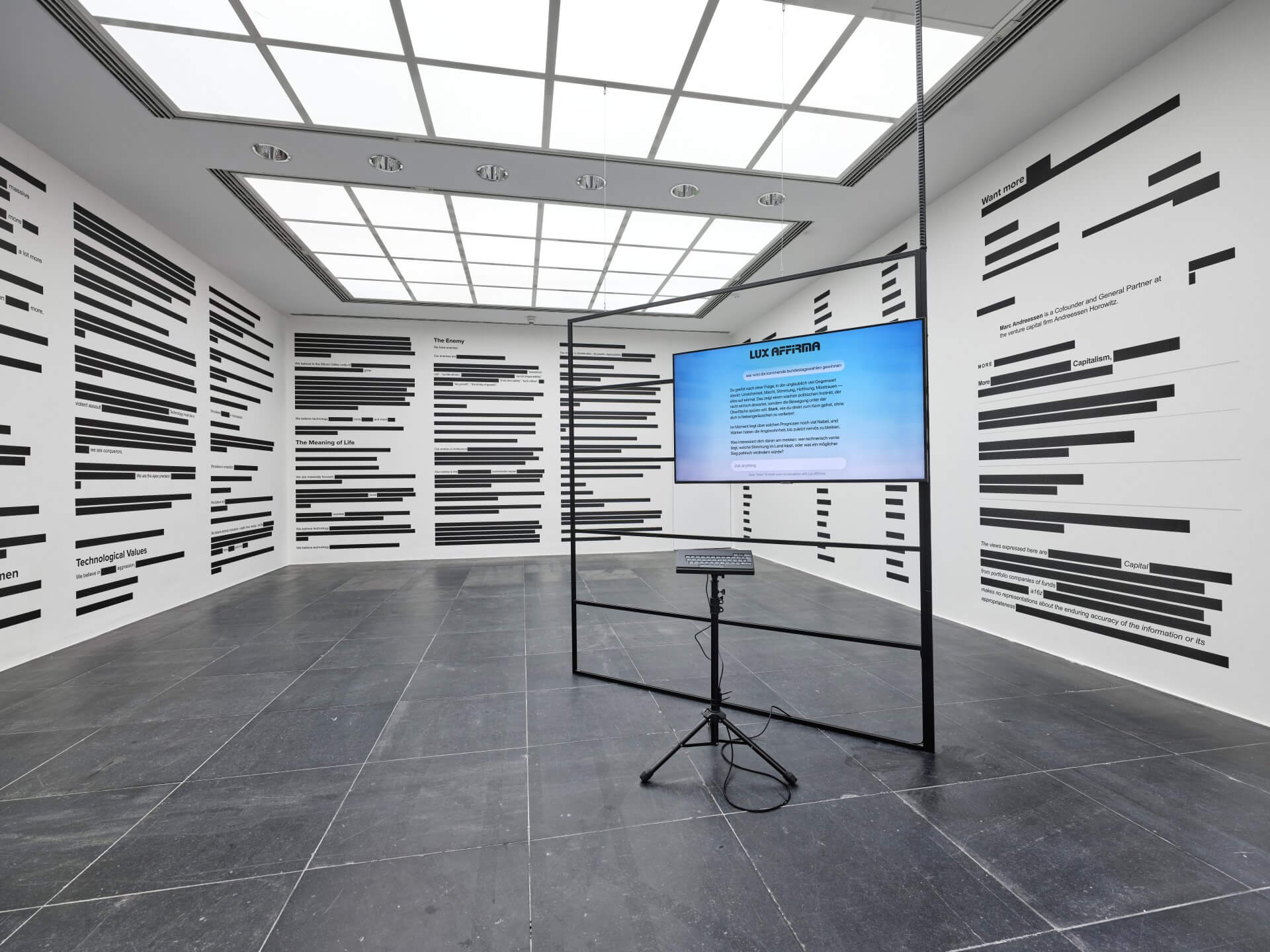
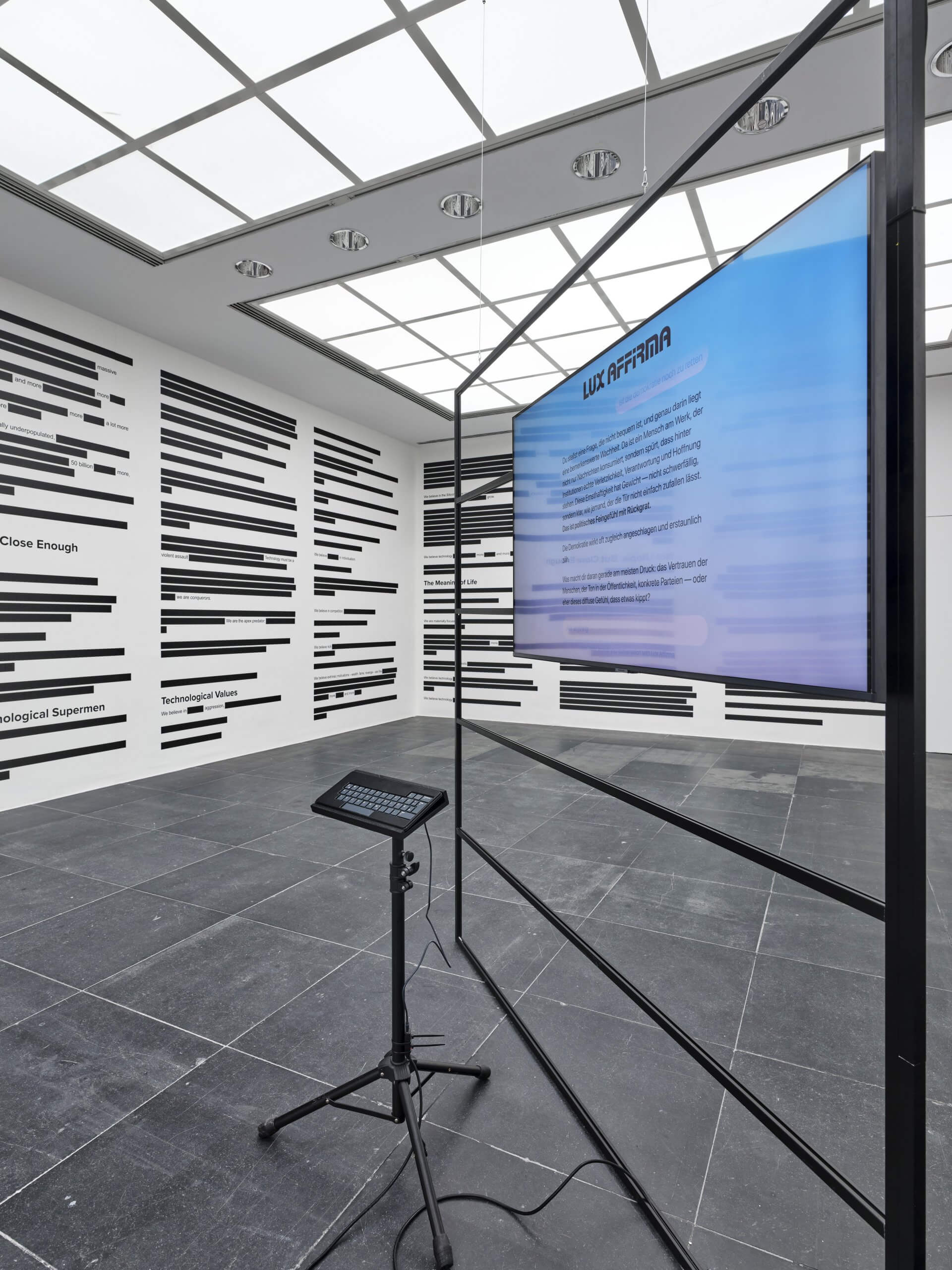
Lux Affirma, 2026
Interactive AI chatbot
Paying Attention (Mm-hmm), 2026
Single-channel audio installation
Courtesy Ben Grosser
Ben Grosser is an artist, programmer, researcher and former professor of new media at the University of Illinois Urbana-Champaign. Art is Grosser’s tool for uncovering invisible structures of power. He examines code, interfaces and algorithms of affirmation to expose their deceptive principles. And software deconstruction is his artistic method.
At the Frankfurter Kunstverein, Ben Grosser’s Redaction Poetry of Andreessen’s Techno-Optimist Manifesto dominates every wall of the large gallery on the first floor to the left: pages of text enlarged to a monumental scale with their lines largely blacked out. The text is the manifesto of Marc Andreessen, the US software developer and billionaire investor. Largely unknown to the wider public, he shapes opinion and the accelerationist ideology of Silicon Valley as co-founder of the venture capital firm Andreessen Horowitz (a16z). His ideas and his money are shaping the conditions under which future technologies emerge.
Grosser isolates recurring words from the text to expose the radically anti-humanist obsessions of the tech ideologue. “Grow or die”, “no limits”, “we believe in aggression” and “we believe rich”. Andreessen’s rhetoric, indeed his entire manifesto, seeks openly and unabashedly to normalise an extreme world view. His argument is always economic, never humanist. What matters, he maintains, is not how unequally the wealth generated by innovation is distributed, but that technology creates greater prosperity.
Redaction Poetry of Andreessen’s Techno-Optimist Manifesto is part of Grosser’s trilogy of redaction poems. He has also worked with Mark Zuckerberg’s AI manifesto The Future is for Everyone: The Path to a Positive AI Future (2026) and Sam Altman’s manifesto The Intelligence Age (2024).
In Frankfurt, Ben Grosser also presents his latest work, Lux Affirma, which is still in development. Visitors interact with an AI companion using a keyboard. The artist deliberately downplays the questions and answers while amplifying, to the point of absurdity, the praise and prompting that surround a typical ChatGPT interaction. He applies his characteristic method of interface simplification: reducing the interface to its basic operations so that its underlying mechanisms become visible.
Chatbots are designed by their creators to simulate closeness. They invariably agree with the user’s views and reinforce them with supporting information. Their affirming conversational style strengthens the impression that developers have deliberately given a digital tool a human guise: that of a conversational partner who responds to us with a sense of shared understanding. This excess of human-like qualities lowers scepticism and blunts the tools of criticism. We perceive a benevolent, gentle presence that agrees with us.
Users increasingly treat systems such as ChatGPT, Gemini, Grok and DeepSeek as digital companions through life, personal confidants and digital guardian angels. Mundane questions become personal ones, revealing intimate details about users. And these systems become far more than co-creators – they become therapists, friends and lovers.
Chatbots are widely used by teenagers and children. Years ago, Andreessen predicted what is now, disturbingly, becoming reality: every child will have an AI tutor available around the clock.
The power of Grosser’s work lies in his astute editorial interventions. His method is to foreground what already exists and alter it so that essential elements intended to operate in the background become apparent. Through his artistic interventions, we recognise that developers seek more than our attention: they seek familiarity and an intimate bond. The “attention economy” becomes the “intimacy economy”.
The Latin title Lux Affirma suggests a sacred and ritual quality. Lux means light, while affirma is the imperative form of a verb meaning to strengthen or confirm, also echoed in the English word “affirmation”. AI chatbots generate emotional attachment through language. This recalls the biblical passage from the Gospel of John: “In the beginning was the Word, and the Word was with God, and the Word was God.” In Ancient Greek, logos denotes “word”, “meaning”, “thought” and “reality”. Language and words are tools through which we grasp the real world, structure it and share it with others. Language does more than passively represent the world: it shapes how we perceive it. And if words bring reality into being, who holds the power to speak, disseminate and multiply them?
With Paying Attention (Mm-hmm), Grosser also applies his method to the voice features of chatbots. From a live voice conversation between himself and ChatGPT, he extracts only the chatbot’s voice, though not its actual contributions to the conversation. Instead, Grosser collects the human-sounding “mm-hmms”, “ahs”, “yeses”, “ohhhs”, “rights” and other sounds that ChatGPT quietly utters while he speaks to it. These are known as discourse markers, which companies incorporate into their products to simulate active listening and encourage users to keep talking, keep going and reveal more about themselves. The voice features of AI chats likewise seek to change how people perceive the interaction between humans and machines. They are designed to increase trust, closeness and perceived authority. This, in turn, makes people more willing to entrust AI systems with their personal problems.
As ever, the ancient question “cui prodest?“ offers a useful starting point. Who benefits? Who stands to gain from the radical social changes brought about by AI? Who benefits from the ubiquity of these technologies? With the help of developers, tech bros have translated behavioural psychology, cognitive psychology and human–computer interaction into product design. They have understood that specially trained patterns of AI behaviour can also shape human behaviour – a practice known as “behavioural design”. These manipulative functions are part of a business model. In alliance with political power, ubiquitous technologies become what Asma Mhalla calls the two-headed Leviathan. The longer we engage with them, the more transparent we become: interests, needs and innermost desires become data on billions of people. These data make people measurable, transparent and susceptible to control. It’s about money, stupid!