

Ein Statement von Laali Lyberth
Dear members of the press,
Dear friends of art and literature,
Dear supporters of Greenland,
It is with both honour and a heavy heart that I stand before you today. I am here to represent my relative, my family, artist, Julie Edel Hardenberg and her husband, Svend Hardenberg who both unfortunately cannot be with us today. Julie asked me to speak on their behalf, and I immediately said of course.
My name is Laali Lyberth. I am a Kalaaleq – an Inuk, a Greenlander. I was born and raised in Nuuk, the capital of Greenland/Kalaallit Nunaat.
Today, I live in Daun, in the heart of the Eifel, with my husband, Sven Nieder – and our daughter Nivikka. We run a publishing house, and since October last year, I have had the honor of leading Inuit Verlag, dedicated to bringing Kalaallisut/Greenlandic literature into the German language.
Though I have made a home here in Germany, my heart remains deeply rooted in the Arctic.
This exhibition – Greenland – Not For Sale – Kalaallit Nunaat Forever is more than an art show. It is a statement. It is a window into a land that has been exploited, and too often silenced.
What do we really know about Greenland? What do we know about its people, its history, its pain, and its resilience? This exhibition invites us all to look deeper and to confront the complex realities of colonialism, climate change, and the longing for independence.
Julie’s art is political, personal, and profoundly necessary. Her work gives a voice to our people that persist despite centuries of colonization.
One of Julie’s most powerful pieces,
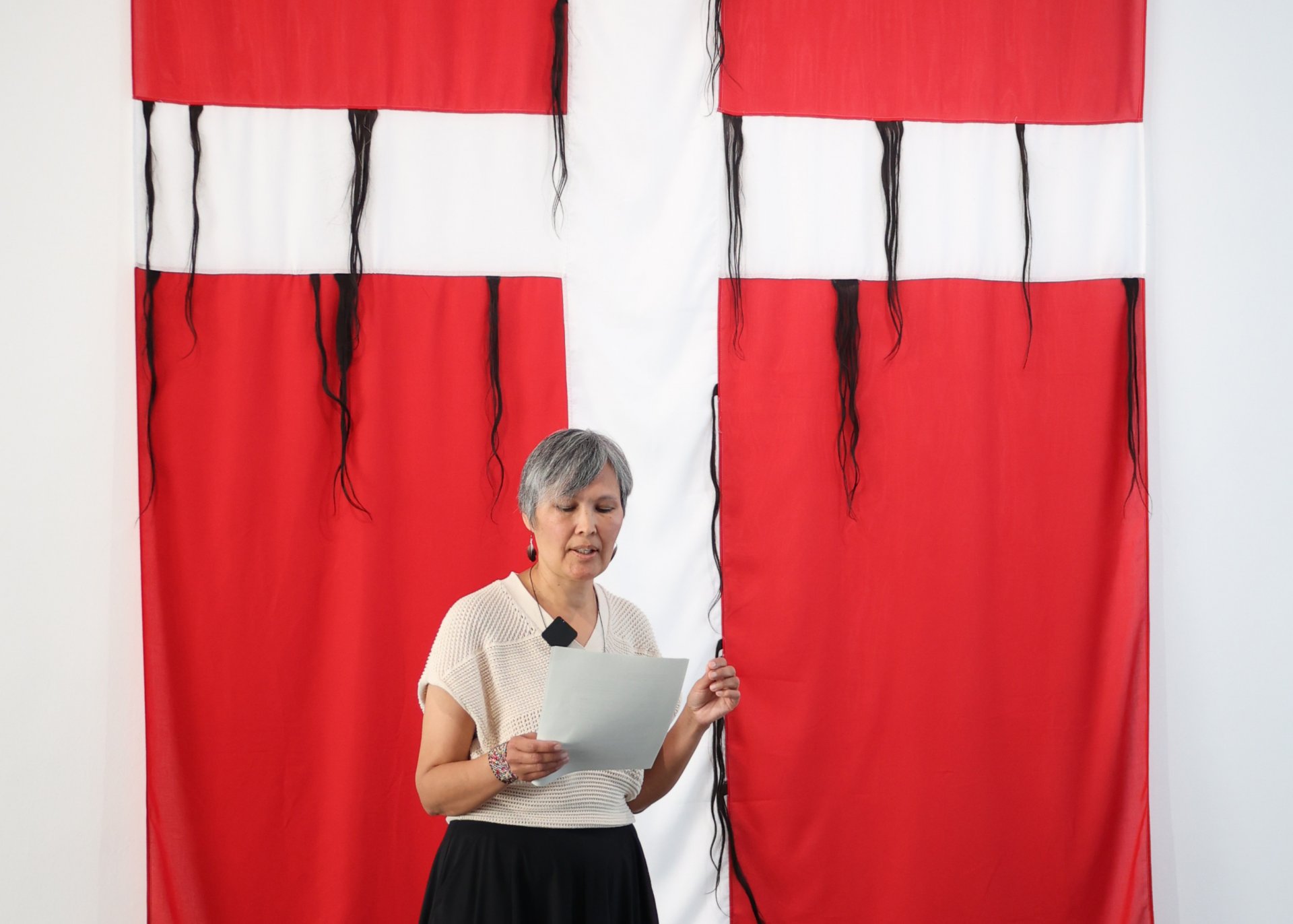
Nipangersitassaanngitsut, meaning Those who can‘t be silenced, consists of an enormous Danish flag – Dannebrog – woven into its fabric are strands of dark hair. I remember clearly the night Julie showed me this flag.
I was speechless. It moved me. It descriped me. I had tears.
Julie’s flag bear witness to the voices that have been silenced and the countless lives lost to colonial, theft of language, culture, and land.
Julie’s language project Ikioqatigiilluta– meaning lets do it together – it was a six-month commitment to speak only Kalaallisut, the Greenlandic language, in Greenland. It might sound unusual for you, a language project to speak your own language in your own country, but if you do that in Nuuk, there can be servere consequences as Nuuk’s power or elite langauge, is still to this day, danish. This quiet insistence on our own language is still seen as a resistance – and that reveals how deeply colonial structures remain embedded in society and in ourselves.
As part of today’s event, we will also be screening the documentary Stella Polaris Ulloriarsuaq, a film that takes us deep into the heart of Greenland’s changing landscape.
This project was guided by the Greenlandic shaman, Angaangaq Angakkorsuaq – the eldest in my family, my father’s older brother – who carries a message:
„It is easy to melt the ice on the ground. The hardest thing is to melt the ice in the heart of man. Only by melting the ice in the heart of man does man have a chance to change and begin using his knowledge wisely.“
I had the honor of organizing this project, together with filmmaker Yatri N. Niehaus, photographer Nomi Baumgartl, and my husband, photographer Sven Nieder. I invite you to experience this film with open eyes and open hearts.
I also want to speak briefly about Inuit Verlag. Our mission is to bring Greenlandic literature to German-speaking readers.
Today we are proud to present two of our publications: Bestiarium Groenlandicum and Sila. These are not mere translations – they are acts of cultural preservation and invitations to see Greenland as a nation with a living, evolving culture.
I’m also happy to announce that Stella Polaris Ulloriarsuaq will have its second edition at the Frankfurt Book Fair this year.
Ladies and gentlemen, Greenland is not for sale.
We Inuit/Kalaallit/Greenlanders: We are artists, we are writers, we are activists, we are filmmakers, and we are thinkers who refuse to be silenced. We are reclaiming our narratives, our language, our land, and our future.
This exhibition, this film, these books – they are all part of that reclamation. They are reminders that Greenland is not a blank canvas for others to project their fantasies or ambitions upon.
On behalf of Julie and on behalf of all those who carry the stories of Greenland in their hearts – I thank you for being here today. I thank the Frankfurter Kunstverein for hosting this vital exhibition, and I thank the ALPS Swiss Alpine Museum and team for their collaboration.
I will end with these words from Julie:
“my language is the landscape through which I navigate-so full of life and traces of living. I know my landscape-it isnt like yours.
Qujanarujussuaq. Vielen Dank.